
I Started Posting on LinkedIn. Here’s What Happened.
It's weird hitting “post.” What happens after is even weirder.

TL:DR | 3 Second Summary
I tested posted on LinkedIn for 3 months to see what I could learn
The platform can seem all over the place
The most important thing is have a plan and start posting
I used to treat LinkedIn like a résumé graveyard.
I started using it differently recently because, well, I felt like I had to. It’s not only something I need to know for clients but, critically, in running my own agency. Not as a social network, but as a business tool.
This wasn’t my first social experiment. A while back, I revealed learnings from posting on TikTok for 90 days. This time, I applied the same curiosity to LinkedIn: what works, what doesn’t, what feels gross, and what actually builds trust.
Here’s what I’ve learned so far.
1. Hitting “post” is the hardest part.
Putting yourself out there on LinkedIn feels weird.
Even if you are an expert. Even if you do know what you’re talking about.
Here’s why: LinkedIn isn’t just “posting.” It’s positioning. The second you start writing in that space, you feel like you’re cosplaying as a Thought Leader™️. (Or, at least I do.)
“Who am I to say this?”
“What if no one engages?”
“What if too many people do?”
If it feels weird, it probably means you’re doing something right. It means that you’re taking it seriously. And it means that you’re showing up in the way that makes the most sense for you.
2. There’s a lot of crap out there.
I say this with love: the LinkedIn voice is unbearable.
You know the one. The 💡Big Idea💡 that wraps up with a bland platitude about resilience. The humblebrag disguised as a lesson. The “What I learned from getting fired by my boss and rehired by my purpose” narrative arc.
There is so much noise and pressure is high to join it. Don’t. Take the time to say something you actually mean. If it takes you 30 minutes longer to get to a post that reflects your voice, your values, your perspective—that’s time well spent.
The world doesn’t need more swirl. It needs specificity.
3. Posts take a long time to pick up steam.
This isn’t the old days of Twitter. It’s not even current Instagram. It’s not even what LinkedIn used to be.
The algorithm on LinkedIn plays the long game. One of my posts gained traction three weeks after I hit publish.
That means you can’t treat LinkedIn like other social platforms. Engagement doesn’t happen instantly. And more importantly—don’t assume something flopped just because it didn’t go viral in 24 hours. Let it breathe.
4. That viral post? I almost didn’t publish it.
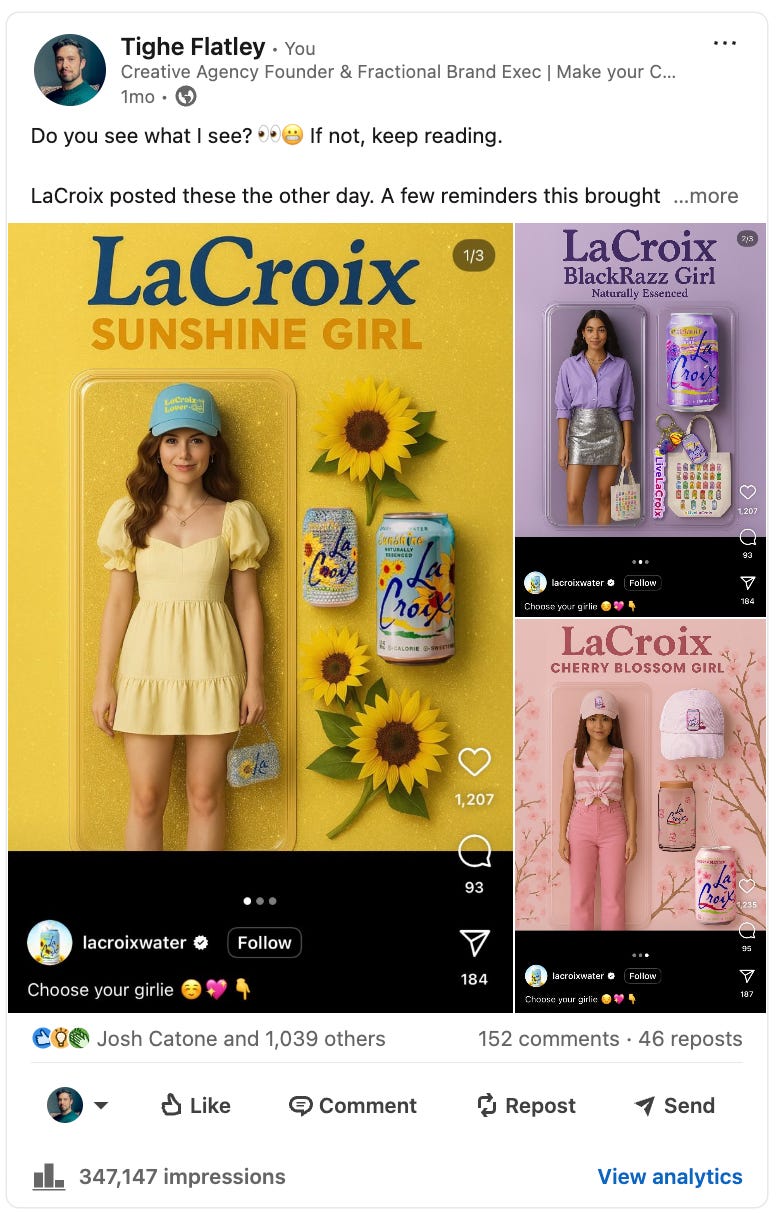
The one post that really took off for me was about a LaCroix campaign. And I almost didn’t hit send.
I spent a lot of time editing that post to make sure it wasn’t just a takedown. I didn’t want to just post a criticism; I wanted it to be useful. Smart. Strategic. A creative analysis that reflected the kind of work I do with clients.
In the end, it worked. It generated discussion. It showed people how I think. And I’d like to think it added something to the conversation vs. just posting about “adding something to the conversation”.
Will LaCroix hire me? Who knows.
Will someone like LaCroix hire me because of it? Hopefully.
Should you hire me? Yes. Obviously. I’m very good.
5. Media matters.
Photos, carousels, videos, docs—use them.
LinkedIn is actively promoting new formats, and posts with visual or interactive elements tend to perform better.
I found that multi-image posts (like the big one above) performed the best. It’s not just me — Metricool recently published an analysis of 577,180 (!) posts and found that carousels had the highest engagement rate, as did this SocialInsider study with an average engagement of more than 6%.
6. Try the new stuff.
Polls, newsletters, audio events, documents—LinkedIn keeps rolling out features and giving them algorithmic love.
If you see a new format or tool pop up, test it. Even if it feels clunky at first. That early adopter energy pays off. Plus, then you can post about what you learned. Two birds!
7. Prepare for an avalanche of cold pitches.
Once you start posting regularly, your inbox will swell with random pitches, spammy DMs, and the occasional “we help agency owners like you 10x pipeline” promise.
Some of it’s fine. Most of it’s noise.
Before you get started, get really clear on why you’re using LinkedIn. Is it to grow your client base? Share your POV? Keep your network warm? Establish authority?
If you’re not sure what your strategy is, the distractions will distract you fast.
Final Thought: Strategy is a Living Thing
The humbling truth here is I don’t think I’ve cracked LinkedIn — yet.
I’m still figuring out my tone. Still wondering how useful my posts actually are. (I think this will always be the case.) Still wondering if it will drive bigger business in the long run.
But I’m going to keep showing up. Because that’s the only way to get better. And because I believe that good strategy doesn’t stay fixed. It moves. It adapts. It evolves.
Just like we do.
👋 Want to see this experiment in action?
Follow me over on LinkedIn. I’ll be the one overthinking, editing too much, and slowly figuring it out in real time.